
Designing Matchbox
How I launched a consumer social app


Last year, I convinced people on the internet that rating their friends’ relationships was a good idea.
The app was called matchbox: ship ur friends. Within six months, it launched on the iOS App Store, was released in four high schools, and got almost 1,000 users. It was ultimately sunsetted due to bullying.
Building a consumer social app has been a challenging but rewarding journey. I’m grateful to have seen it all the way through, and even prouder to share what went on behind the scenes to make the app possible. This is how I made matchbox.
1. User feedback loops and iterating quickly
I posted a design that went viral on Twitter. It seemed like everyone had something to say about it, including consumer social veterans Raj Vir (NGL) and Nikita Bier (Gas). People were excited about the possibility of sparking new relationships and exposing their friends. It was at this moment I knew matchbox had potential. I decided to take matchbox seriously and recruited my friend Ibiyemi Abiodun to help. Ibiyemi singlehandedly did all the development and brought matchbox to life.

Matchbox is a function of social proof and social validation. If someone likes you, you want to know who it is. If you have a crush on someone, you want them to like you back. It feels good when you have votes and are shipped, or matched, with many people.
The original design was heavily inspired by NGL. In the early days, I found beta testers by forcibly onboarding almost a hundred friends onto the Testflight (thank you to Verci and my friends who put up with me). I shoved my phone in people’s faces non-stop and pestered them to try it. It was a constant trial-and-error process. Every screen was optimized. We tested flows and pushed updates daily.
One of the biggest hurdles was figuring out how to get users to make a lot of ships. Initially, people ran out of ideas or had decision paralysis. It wasn’t until we moved towards a multiple-choice design (à la Gas) that the app felt more “addicting” and “game-like”.
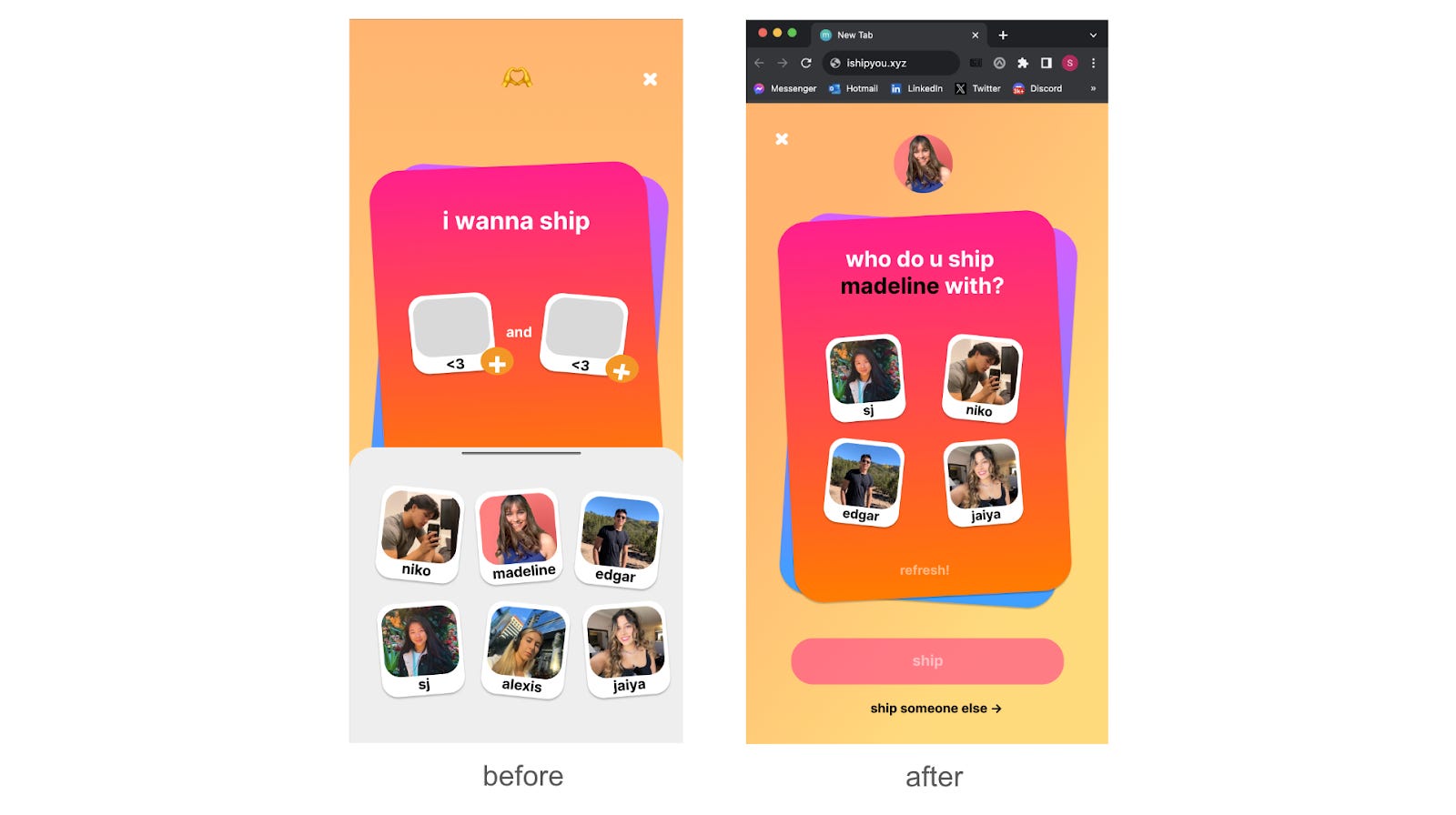
Gamification was the biggest unlock when making design decisions. This insight led to the addition of popularity scores and daily ship limits.
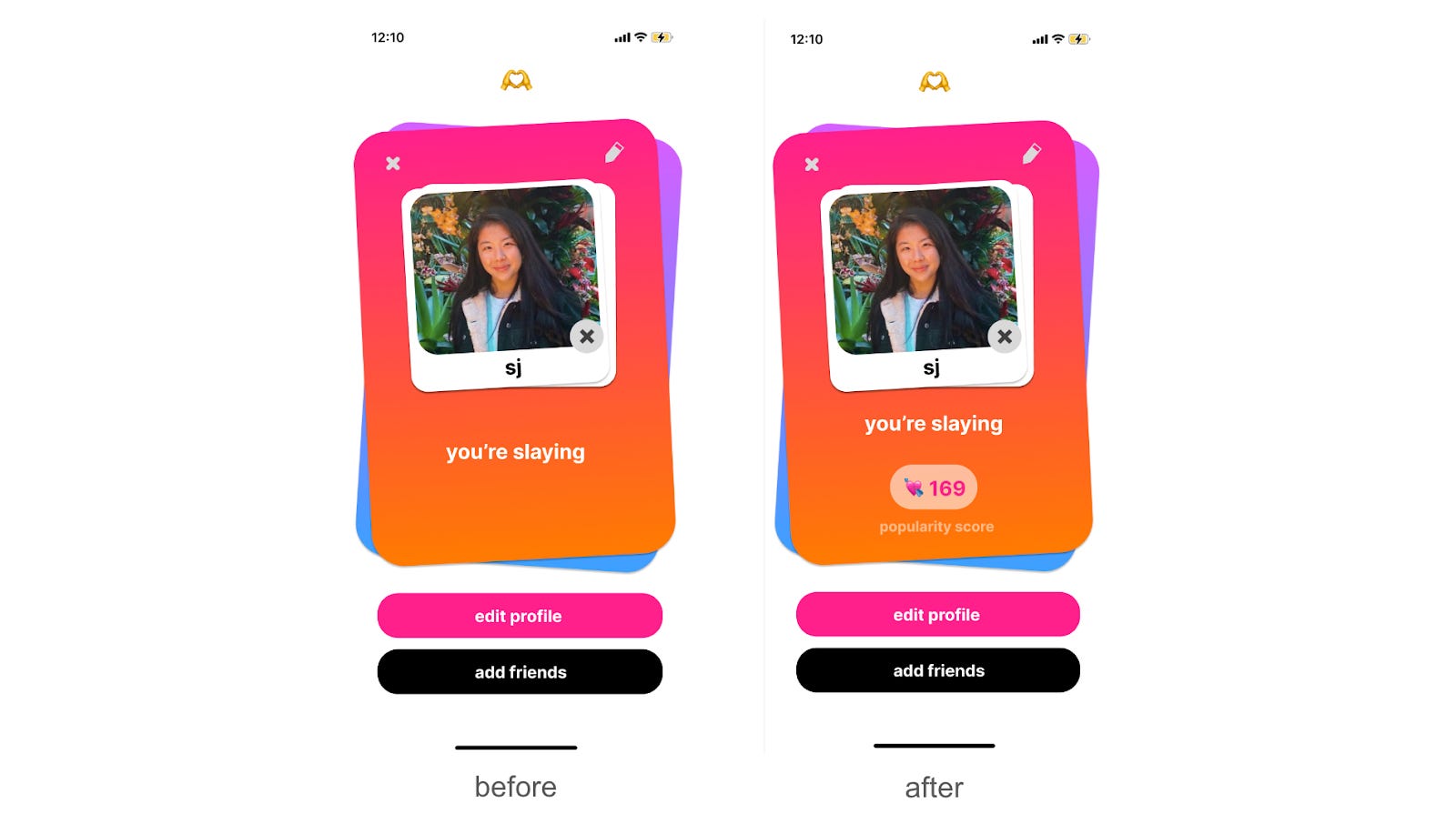
After fiddling with the design for four weeks, matchbox moved from TestFlight to public launch. Matchbox was officially released on the AppStore on October 18, 2023.

2. Creating content on Instagram and Tiktok
Once matchbox was out, I started focusing my efforts on social media marketing, with the help of Swati Gupta. The goal was to go viral. This meant that we had to post consistently, experiment with different types of content, and double down on what worked. We tried various formats, including starter pack memes, photo slides, skits, storytelling, and street interviews. We posted consistently for three months straight and several videos notched 10,000 to 30,000 views on Instagram (my street interviews in Washington Square Park).
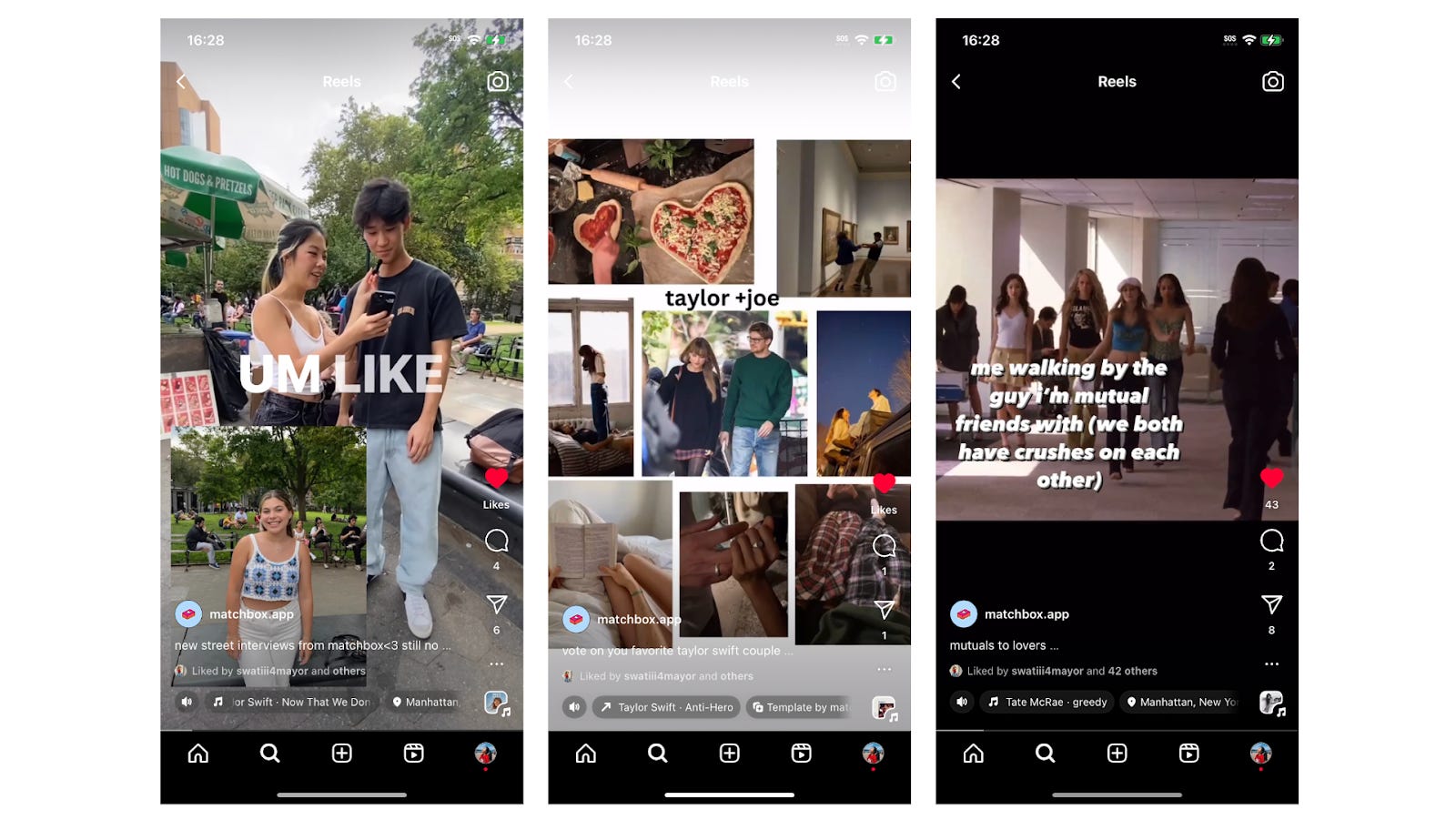
Unfortunately, this strategy failed to get users. Matchbox is an app that thrives off of network effects. Network effects occur when an app becomes more valuable as more people use it (the Cold Start Problem). Social apps, like Gas, Saturn, and BeReal, are prisoners to its network.
However, it’s not just about the size of the network, but whether your friends are also on it. The real value of a network is the relationship between its users. A social app with 100,000 users is objectively better than an app with 10 users, but it’s not when you don’t know any of those 100,000 users. BeReal is no fun if your friends aren’t on it (RIP). In other words, ten BeReal users who are your close and personal friends are more valuable than 100,000 random people you don’t know.
The problem with going viral on social media is that it doesn’t consider users’ relationships with each other. Users download the app because they discovered it on TikTok, not because of their friends. There’s not much to do on matchbox if your friends aren’t on it. This marketing strategy works best for apps that don’t require a lot of friends, like Locket Widget. The Cold Start Problem was why targeting existing networks was more effective for launching matchbox.
3. Recruiting high school ambassadors
Matchbox launched in four high schools and acquired almost 1,000 users. I recruited high school students to be ambassadors, with the help of Matt Alexander.
We found high school students through three main channels: Instagram, LinkedIn, and referrals. On Instagram, I submitted job postings to high school opportunity accounts. If they approved the listing, they posted it on their Instagram. On LinkedIn, I asked high school students to comment on my LinkedIn post. Engagement increases viewership and recommends it to their friends’ LinkedIn newsfeeds. High school students would contact me and refer their friends. Student referrals facilitated the majority of ambassador recruitment. I prioritized ambassadors who had active school involvement, such as being on the school sports team or an executive of a club.
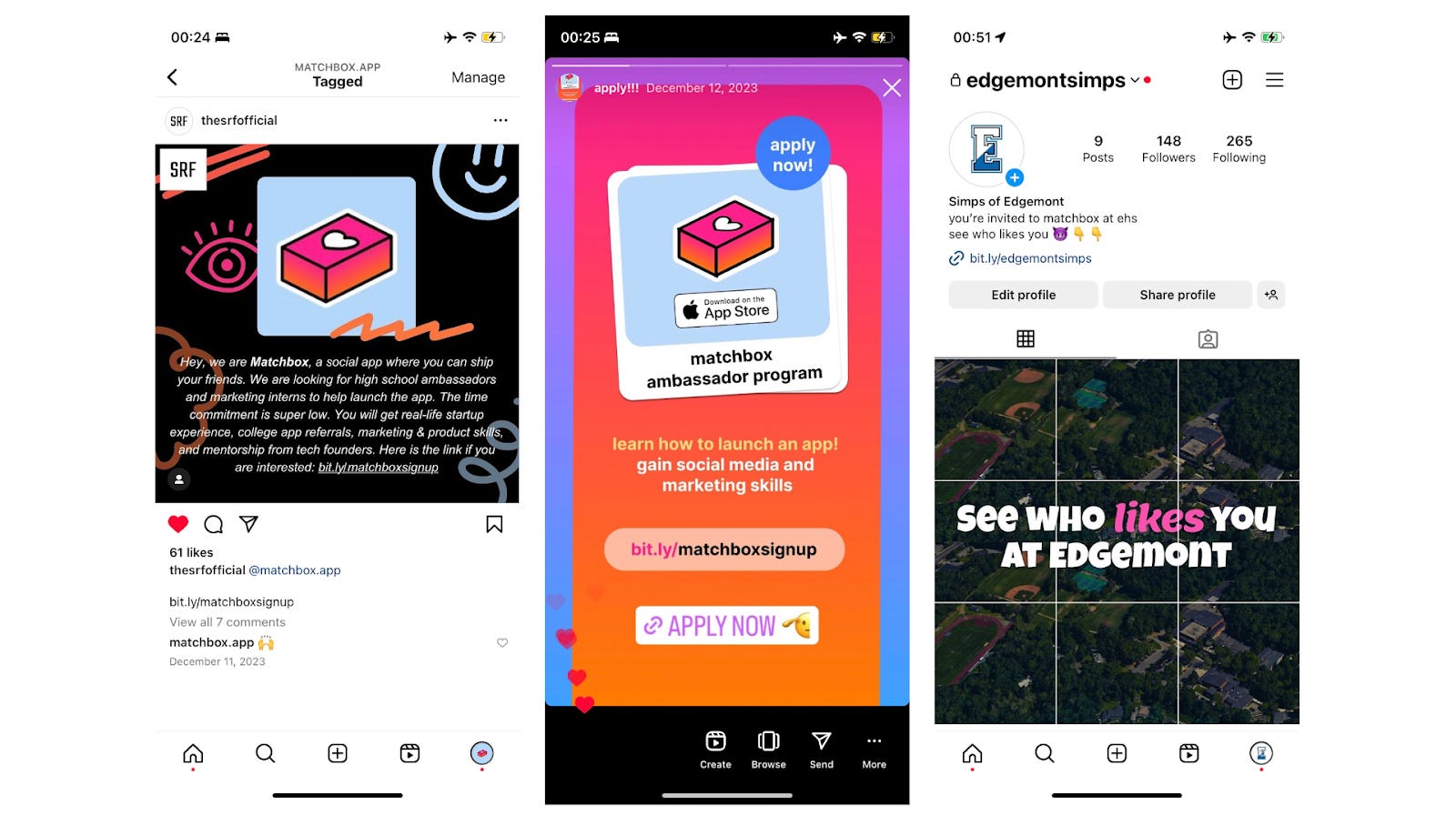
We worked with each ambassador individually on a playbook for their high school. An ambassador’s job was to launch matchbox at their high school by running a school-specific “ship or dip” Instagram account. The playbook was inspired by Nikita Bier’s launch strategy for Gas: A private Instagram account was created and personalized for each school, using the logo and pictures of the school in the profile picture and in-feed posts. Ambassadors were encouraged to follow students on school clubs or sports teams. On launch day, all follow requests were approved and a link to the AppStore appeared in the account description. Downloads were instantaneous.

4. Managing Instagram DMs
I noticed many trends in user behavior while launching in schools. Firstly, in schools where the launch went well, matchbox was popularized by a big friend group. In one school, a well-known student on a varsity team was the first to download matchbox and shipped over a dozen teammates. This spurred the rest of the team to join in and start shipping each other.
Most of the matches were generated by a small number of students. Most students were “lurkers” and never made any new ships.
Lastly, the most popular ships were the most contentious. Unfortunately, this meant students used the app to make fun of their peers. This was my biggest oversight when designing matchbox. I knew bullying was a risk, but I thought the abuse would be isolated to the “leave a note” feature. We planned on integrating an AI anti-bullying API if users were writing harmful messages.
The bullying on matchbox was unique to the app. I didn’t foresee that some of the most popular ships would be based on underage pairings (shipping a freshman and senior student), sexuality (shipping a student who was not yet comfortable with their sexual orientation), or malice (shipping a student with special needs mockingly). I discovered this due to numerous Instagram DMs from students who complained and wanted their ships deleted. This activity was difficult to detect or prevent, and the best course of action was to stop it entirely.
5. Sunsetting Matchbox
Matchbox was sunsetted due to teen bullying. Although matchbox is no longer active, there were some positive moments from ambassadors who enjoyed the experience.
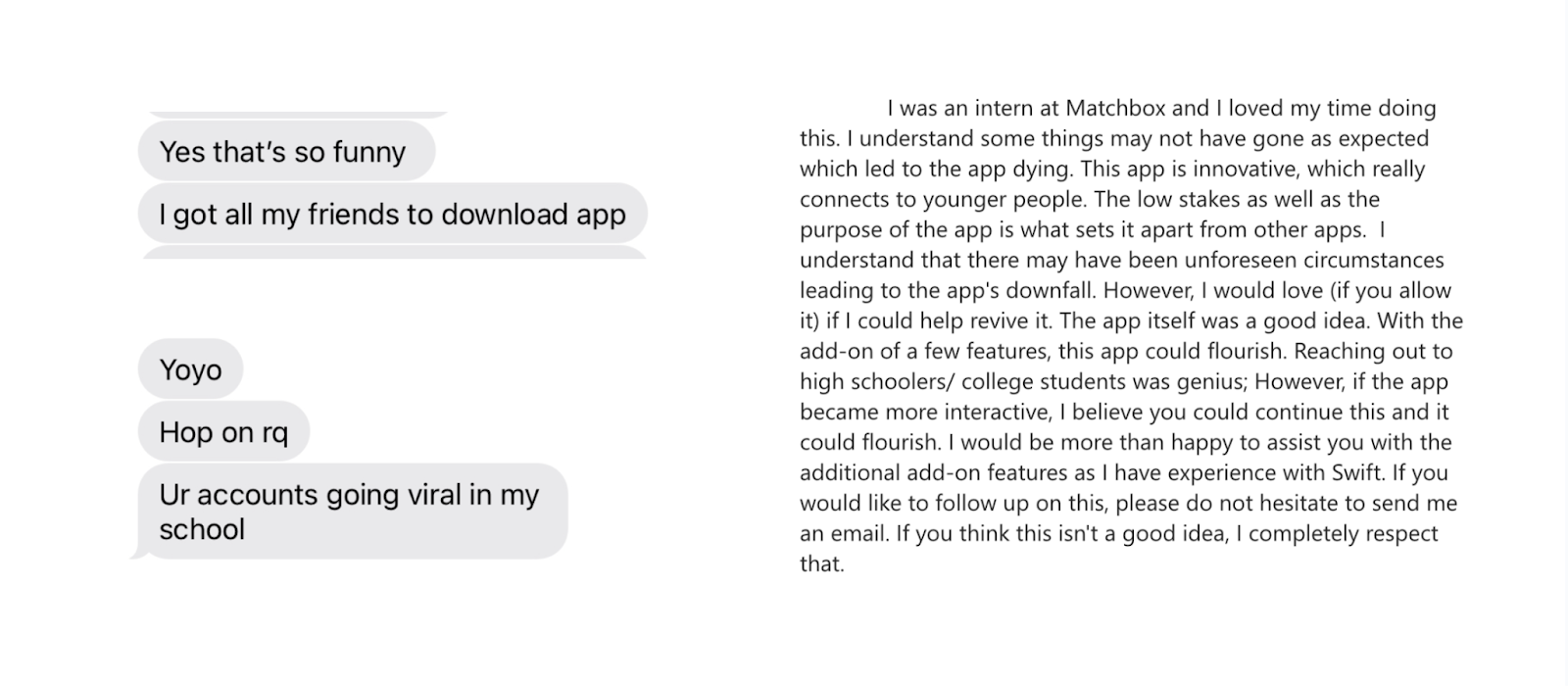
Building matchbox was one of my favorite experiences. If I learned anything, it’s that closing user feedback loops is essential to a successful launch. Consumer social is one of the few industries where the product matters as much as the distribution.
Thank you to Ibiyemi, Swati, Matt, Olivia, Lauren, Verci, the high school ambassador team, and everyone else who offered their time and advice while building this project.
Reach out if you liked this or are working on an app and have questions about matchbox.
Getting 1000 users is pretty insane! Great job!
- Is there really no workaround against bullying? Just thinking more it. Can you have AI agents monitoring chat for instance? Maybe users have to earn their place AKA do some quests etc to unlock all features? Put money on the line? Not sure. Just thinking out loud.
- Some really helpful growth marketing techniques in there. Will be taking notes and trying to see where I can apply them as well
Hi! I'm working on a consumer app targeting a demographic I believe would love the product, but may be hard to market to and hit virality (think people who aren't very social). I would love to hear your thoughts about what I'm building and help me brainstorm over some acquisition strategies to avoid that damn cold start problem! If you're open to it, email me at jpryor812@gmail.com, and I'll get back to you about what I'm building and some questions I'd love your take on. I would REALLY appreciate it! Regardless, thanks for sharing your experience! Matchbox is an awesome idea and I'm sorry it didn't work out. Looking forward to your next big thing!